Medically reviewed by Adria Thompson, Certified Dementia PractitionerSpeech-language pathologist Adria Thompson is the owner of Be Light Care Consulting and specializes in creating easily digestible, accessible, and practical dementia content.
More info
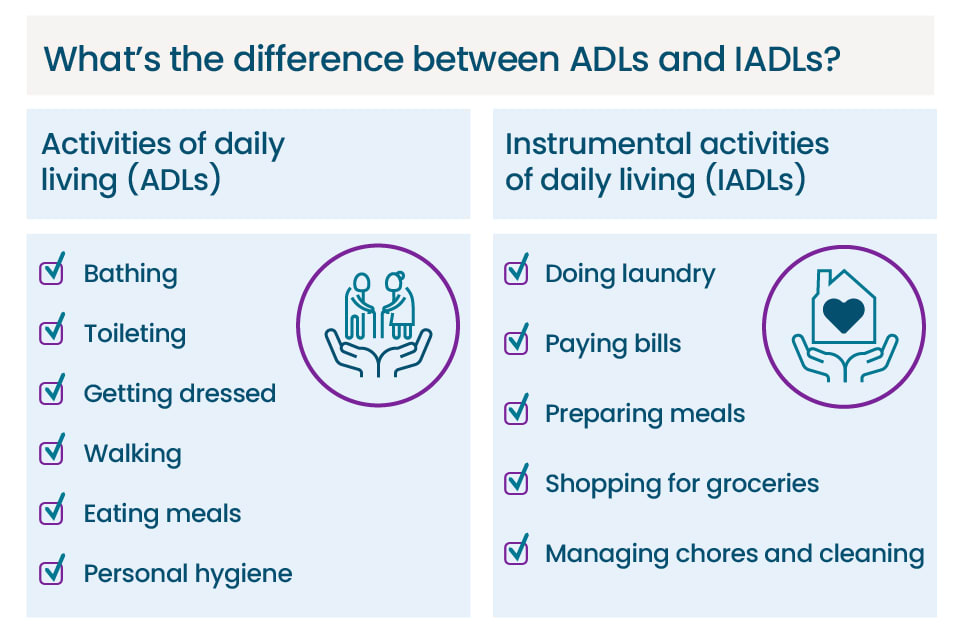
Activities of daily living (ADLs) and instrumental activities of daily living (IADLs) are tasks that independent adults can do on their own. ADLs include feeding, getting dressed, bathing, toileting, managing continence, and transferring, or moving from one position to another. IADLs are more complex and include transportation, money management, shopping, meal preparation, housecleaning, communication management, and medication management. A person’s ability to complete ADLs and IADLs determines what kind of care they need and how much they need.
Let our care assessment guide you
Our free tool provides options, advice, and next steps based on your unique situation.
Activities of daily living (ADLs) are basic tasks a person has to do on their own to live independently, such as bathing, showering, dressing, and mobility.
Instrumental activities of daily living (IADLs) are more complex activities a person does to care for themselves and their home, including cleaning, managing money or medications, shopping, and preparing meals.
Companies that provide long-term care insurance typically use a person’s ability to complete ADLs and IADLs to determine their eligibility for benefits.
When someone needs help with at least two ADLs or IADLs, that’s an indication that in-home care or residential care may be needed.
What are ADLs and IADLs?
Activities of daily living (ADLs) are basic tasks needed for everyday life, while instrumental activities of daily living (IADLs) are more complex tasks needed to function independently and manage one’s own affairs.
Research shows that individuals over 85 generally need assistance with daily living, with more than 20% of seniors over 85 needing help with one or more the following ADLs.[01,02]
Bathing and showering: The person can take a bath or shower on their own on a regular basis.
Continence: The person can completely control their bladder and bowels.
Dressing: The person who can select appropriate clothes and outerwear for the weather or occasion and get dressed independently.
Mobility: Someone can move or transfer from one place to another, such as in and out of a bed or chair.
Feeding: Someone can get the food from the dish to their mouth, chew, and swallow. Feeding doesn’t include meal preparation, which is an IADL.
Toileting: A person can get on and off the toilet and clean oneself without assistance.
Let our care assessment guide you
Our free tool provides options, advice, and next steps based on your unique situation.
Instrumental activities of daily living
IADLs are complex skills that allow seniors to manage everyday tasks and allow them to live independently. IADLs go beyond basic self-care and require planning, problem-solving, and organizational skills.[03]
Housekeeping and home maintenance: The person can maintain a clean and safe home by mopping, doing laundry, or fixing minor things.
Managing money: The person can budget and pay bills on time.
Managing medications: A person can take medications correctly and refill them on time.
Preparing meals: Someone who can plan, cook, and serve their own meals.
Shopping for groceries and other necessities: The person can remember that food and other essentials are needed and is able to get them.
Transportation: A person who can plan to go someplace, and either transport themselves or arrange for someone else to transport them.
Communication management: A person who can plan to communicate, and do so using appropriate methods, such as the phone, mail, or email.
How are ADLs and IADLs assessed?
Someone’s ability to complete can be determined informally through personal observation by the senior themselves or by family caregivers. Health care professionals, such as nurses and physicians, typically use a formal assessment tool.
FROM THE EXPERT: THE IMPORTANCE OF ASSESSING ADLS
If someone is concerned about their mom, then knowing how they’re doing with ADLs is important. It can educate a person and take them from feeling like ‘Mom needs help, I’m worried,’ to be able to answer questions like, ‘OK, where does she need help?’
A deeper understanding of your loved one’s ability to perform ADLs and IADLs can help your doctor identify ways to improve function, including medical treatment, mobility devices, and various therapies. It can also help doctors create a care plan that supports your loved one’s needs.
Self-report
A person can assess themselves based on their understanding of how well they’ve been able to complete ADLs and IADLs in the past. Keep in mind that self-reporting can introduce bias, as your loved one may not report that they need help because they don’t want to be a bother, for example.
Caregiver assessment
Family and professional caregivers often notice when a senior needs more assistance than they used to. For example, a parent may start asking for help in situations they could once handle alone.
FROM THE EXPERT: SIGNS IT'S TIME TO ASSESS ADLS AND IADLS
Pay attention to their driving habits. See if there are any signs of accidents or close calls, or if passengers feel worried when riding with them.
Check for health concerns. They may be more prone to falls or have had repeated trips to the ER or hospital recently.
Watch for signs of financial struggles. Look for unpaid bills or bounced checks sitting out, or for declined transactions when you’re out together.
Notice trouble with their memory. They may be forgetting important things or using poor judgment, which can put them in danger.
To help you assess and monitor your loved one’s activities of daily living, use A Place for Mom’s ADL and IADL checklists. After assessing your loved one, consider taking the results with you the next time your loved one has a medical checkup.
Click on the respective images below to download the ADL and IADL checklists.
Tips for assessing your loved one’s ADLS and IADLs
As you assess your loved one’s ability to complete ADLs and IADLs, follow these tips from Dr. Leslie Kernisan, a geriatrician in San Francisco:
Ask for others’ opinions. Check with your loved one’s neighbors, family, and friends. Inquire about any changes in your loved one’s abilities.
Assess on a spectrum. Ask yourself whether your loved one can do the task a little bit, sometimes, or often rather than a simple “yes, they can do the task,” or “no, they can’t.”
Be patient with slow task completion. “If a person is doing a task more slowly than they used to, it doesn’t mean they can’t do the task,” Kernisan notes.
Consider the time of day and how tired the person is. Many seniors have sharper cognitive abilities and more energy in the morning.
Consider the person’s current health status. If they’re fatigued or fighting a virus, your loved one’s abilities can be momentarily impaired.
Find the time. “It’s common to be in a hurry, and it’s difficult to find the time to observe, but it’s important to take the time, and when you do, be patient,” Kernisan says.
Look at your own preconceived notions about your loved one. Are they interfering with your ability to make an objective assessment?
Make the effort to help correct what you can. Ensure your loved one can live life to the best of their abilities and as independently as possible.
“It’s very challenging to have people see you as less able,” Kernisan says. Family caregivers should “be discreet and empathetic” when assessing for ADLs and IADLs, she suggests.
If your loved one is unable to independently perform daily ADLs and IADLs, or if you have other safety concerns, it may be time to discuss senior care. Increasing support with home care or moving to an assisted living community can help them to live safely and continue their activities with assistance.
Questions to help you identify the level of care your loved one may need
The following questions can help you assess your loved one’s current needs to identify potential care options:
Do you or a neighbor need to check on your aging parent routinely?
Is your aging parent able to continue living independently?
As you track your loved one’s status and plan for future steps, keep in mind that ADL assistance requires more intensive, hands-on care than IADL assistance. In some cases, IADL deficiencies may be managed by different service providers, such as a meal delivery service, a housekeeper, or an accountant. If in-home care services aren’t enough to help your parent complete their ADLs, assisted living communities offer full ADL support for seniors.
Medical team assessment
Families rarely ask about ADLs until a parent or senior loved one is being assessed for long-term care, says Kernisan. She says it’s a good idea to share changes in your loved one’s ability to complete ADLs or IADLs with their medical team. Often, a change in a senior’s ability to perform them requires evaluations that may uncover a medical issue. Health care professionals typically use one of the following three ADL assessments:
The Katz Index of Independence in Activities of Daily Living. This is generally for seniors in long-term care settings, where disability is generally more severe but stable. In this assessment, one point is gained for each ADL your loved one can complete independently. The total number of points at the end of the assessment shows how independent your loved one is and what level of assistance they may need.[02]
The Barthel ADL Index. This assessment covers two additional activities, including grooming and ability to climb stairs. It’s also for care settings and can detect subtle changes in a person’s health. In this assessment, the task levels are on a scaled point system. As with the Katz assessment, the more points you have in total, the more independent your loved one likely is.[04]
The Functional Independence Measure (FIM). This option is more comprehensive, combining ADLs with IADLs and other social activities. This assessment tool comprises 18 items divided into physical and mental categories. Each item is scored on a scale. The higher the score, the more independent your loved one is at performing the task.[05]
Senior care communities and ADL assessment
A senior living community will assess new residents’ ability to complete ADLs when they’re admitted. They also re-evaluate residents’ regularly, according to their own standards and to standards set by state and local regulatory bodies. Understanding residents’ abilities is key to ensuring the appropriate type and level of care is being provided, and to ensuring the facility is properly staffed.
Communities also evaluate residents’ ability to complete ADLs on an as-needed basis, such as when there’s been a change in someone’s cognitive or physical health.
Assessment trigger
How often
Upon admission
One time
Routine re-evaluation
Every 6-12 months
Significant health/cognitive change
As needed
Care plan update/review
Every 6-12 months or as needed
How senior care options can help with ADLs
If you’re worried about your loved one’s ability to perform everyday tasks, talk with their doctor to discuss your concerns. Identifying any limitations your loved one may have can help you get them the support they need.
Home care
If your loved one needs help with one or two ADLs, in-home care can be a cost-effective option.
The role of ADLs and IADLs in insurance coverage for home care
Many seniors use private long-term care insurance or veterans benefits, such as the Aid and Assistance benefit, to pay for home care. If your loved one has long-term care insurance or is eligible for veterans benefits, they’ll likely be evaluated by a home health nurse to determine what kind of assistance they need.
Some private long-term care policies require the policyholder to demonstrate that they need help with a certain number of ADLs to begin using the policy’s benefits.[06] Similarly, the VA requires beneficiaries to need help with at least two ADLs before they’ll cover the cost of home care through the Aid and Assistance benefit.[07]
If your loved one needs help with ADLs, it’s also important to understand the details of their insurance policy and ensure that the receipt for caregiving services reflects that they’ve received all the help they’re approved for. For example, some insurance companies will deny a day’s claim if it’s documented that the policyholder needs help with three ADLs but only received help with one ADL.
Assisted living
For people who need help with more than two ADLs and one or more IADLs, assisted living may be more appropriate. Assisted living communities within A Place for Mom’s network help with these ADLs and IADLs:[08]
Over 96% of communities provide meals.
Nearly 98.6% of communities offer incontinence care.
Almost 90% of communities offer medication management services.
Over 83% of communities offer housekeeping services.
About 80% of communities offer laundry or dry-cleaning services.
About 93% of communities offer transportation services.
“We look at assisted living in a community setting as a way for seniors to thrive, not just survive. So, it’s great when families see improvement in their loved one’s overall health and well-being,” says Niki Gewirtz of a Place for Mom, who has more than two decades of experience in senior living communities.
Gewirtz stresses that the improvements that family members notice are usually happening because their loved one is getting help. “They’re getting proper nutrition, and their medications are being managed appropriately,” Gewirtz says.
“Sometimes, a family will decide that their loved one is doing so much better that they can go home,” she says. So, they go home, stop getting that support, and are back in the community in a short period of time. “The reason they got better was someone was helping them with ADLs,” Gewirtz explains.
Talk with a Senior Living Advisor
Our advisors help 300,000 families each year find the right senior care for their loved ones.
How to find the best senior support options
If you’re ready to explore options for helping your loved one with ADLs or IADLs, reach out to one of A Place for Mom’s Senior Living Advisors. At no cost to your family, an advisor will work to understand your parent’s unique situation and needs, compare different care options, and offer personalized referrals.
Families Also Ask
What's another word for activities of daily living?
Activities of daily living, or ADLs, are also sometimes referred to as personal care tasks or self-care tasks.
How do ADLs affect eligibility for assisted living?
When someone needs help with one or two ADLs, an assisted living community can provide the support they need. If someone needs help with several ADLs, or if they need help with one or two ADLs and they have complex medical issues, a nursing home may be more appropriate.
Are there tools or devices that support someone being able to complete ADLs independently?
Yes, there are several assistive devices and technologies that help people complete their daily personal care tasks on their own. The non-profit organization, United Disabilities Service Foundation , connects people to assistive tools.
Susanna Guzman is a professional writer and content executive with 30 years of experience in medical publishing, digital strategy, nonprofit leadership, and health information technology. She has written for familydoctor.org, Mayo Clinic, March of Dimes, and Forbes Inc., and has advised Fortune 500 companies on their content strategy and operations. Susanna is committed to creating content that honors the covenant between patients and their providers.
Angelike Gaunt is the Director of Content Strategy at A Place for Mom. She’s developed health content for consumers and medical professionals at major health care organizations, including Mayo Clinic, the American Academy of Family Physicians, and the University of Kansas Health System. She’s passionate about developing accessible content to simplify complex health topics.
Speech-language pathologist Adria Thompson is the owner of Be Light Care Consulting and specializes in creating easily digestible, accessible, and practical dementia content.
The information contained on this page is for informational purposes only and is not intended to constitute medical, legal or financial advice or create a professional relationship between A Place for Mom and the reader. Always seek the advice of your health care provider, attorney or financial advisor with respect to any particular matter, and do not act or refrain from acting on the basis of anything you have read on this site. Links to third-party websites are only for the convenience of the reader; A Place for Mom does not endorse the contents of the third-party sites.